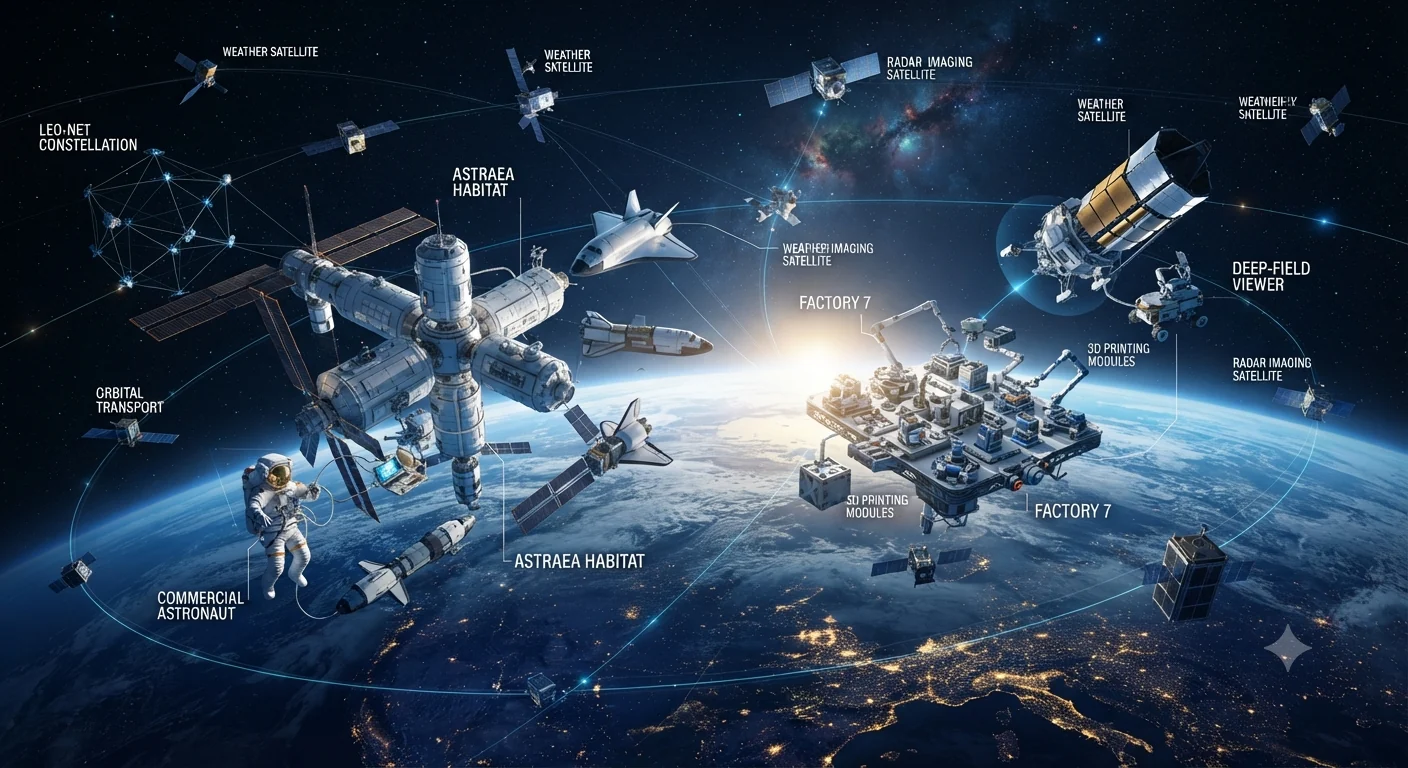
Commercial space infrastructure includes services already in use, experiments conducted in orbit and systems still being designed. This article follows three connected areas: activity in low Earth orbit (LEO), infrastructure proposed for deeper-space missions, and automation within spacecraft operations. These are an editorial framework, not a ranking of markets or a forecast of their value. The practical question is what a system has demonstrated, what remains to be tested and which other services it would need to work reliably.
Here, operational means a service is in use; demonstrated means a capability has been tested under stated conditions. In development describes engineering work before the intended service is established. Proposed or planned describes an intended mission or facility, while a long-term concept may still depend on unresolved technical and economic assumptions. Success at one stage does not establish readiness for the next.
Commercializing Low Earth Orbit
LEO supports communications, observation and research, but those activities have different operating requirements. A satellite service needs spacecraft, ground connections and usable coverage. A crewed station also needs life support, transport, maintenance and a dependable operating organization. Neither an announced station nor an experiment aboard an existing platform should be counted as an established commercial habitat or factory.
NASA's commercial space station program supports the design, development and demonstration of privately owned destinations. NASA describes a planned transition from the International Space Station, whose operational lifetime is expected to end in 2030. The intended successor services depend on testing, funding, launch readiness and customer demand. Supporting station development does not guarantee an uninterrupted transition or continuous commercial human presence.
Microgravity research investigates materials processing, optical fibers, crystal growth and biological systems. A finding from a controlled experiment is different from repeatable production, and repeatable production is different from a viable business. Hardware reliability, sample return, quality control, yield and transport costs all matter when assessing a potential application.
NASA's optical-fiber research overview describes experiments with ZBLAN, a fluoride glass, and the potential for improved fiber quality in microgravity. These investigations do not establish that every space-produced fiber outperforms terrestrial silica products. Comparisons need measured optical properties, relevant wavelengths and manufacturing conditions. Experimental production should not be described as established industrial-scale manufacturing.
A 2019 pembrolizumab crystallization study investigated a specific antibody under microgravity conditions. It provides an example of pharmaceutical research, not proof that space manufacturing broadly creates superior medicines or directly delivers a new treatment. Formulation development, clinical evidence and manufacturing approval are separate questions.
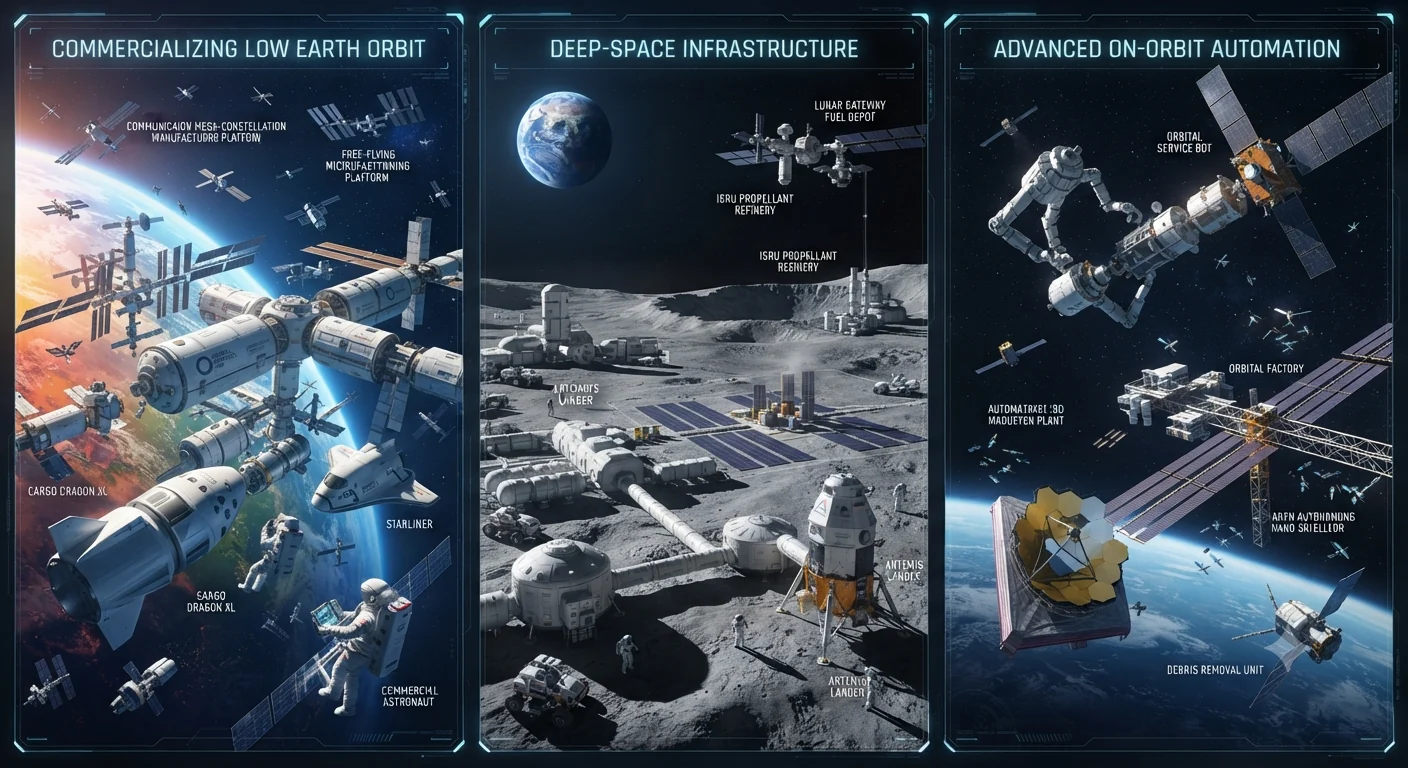
Communications constellations illustrate the importance of evaluating the complete service. Availability depends on orbital coverage, ground infrastructure, terminals and local operating permissions. A satellite count alone does not describe access or performance. Similarly, component-cost comparisons need a named product, production volume and time period; large constellations do not by themselves prove lower costs for every spacecraft supplier.
Deep-Space Infrastructure
Lunar exploration combines individual missions with proposals for services that later missions might share. Communications relays, navigation support, power and transport could reduce the burden on a future lander or habitat. A demonstration of one component, however, does not establish an integrated network, a permanent base or a resource depot.
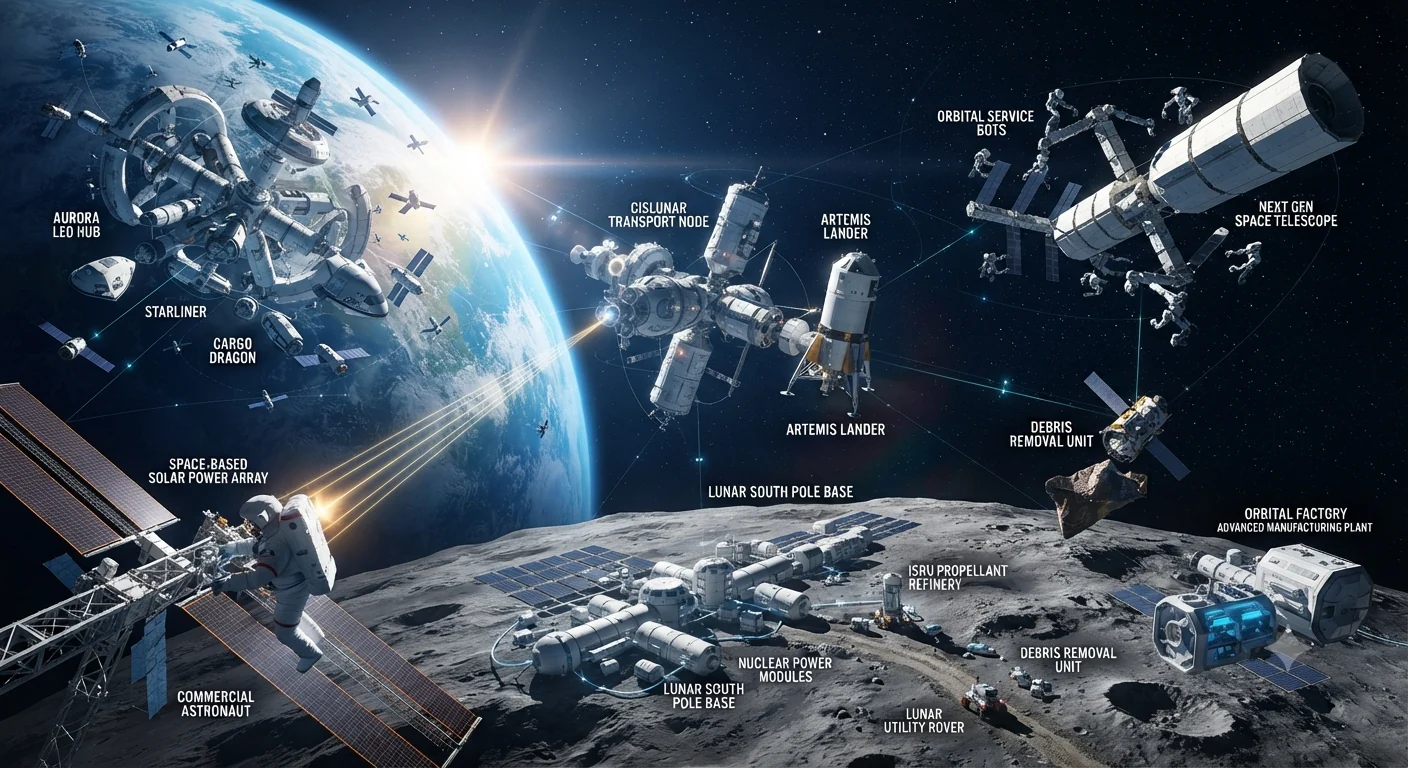
ESA's Moonlight program is developing lunar communications and navigation services. Its intended role is to support future missions through shared infrastructure and interoperable services. It should be understood as a development program, not as evidence that a mature lunar equivalent of terrestrial satellite navigation is already available everywhere around the Moon. Proposed relay or optical links need their own mission-specific status and performance evidence.
Power choices depend on the landing site, illumination, required operating lifetime and demand. A habitat or instrument intended to survive extended darkness needs a suitable energy and thermal-control strategy. Solar generation, storage and proposed fission systems involve different constraints; no single combination is automatically essential for every mission. Polar illumination conditions also differ from the simplified picture of a uniform lunar day and night.
In-situ resource utilization means considering local materials as inputs rather than transporting every resource from Earth. A proposed water-to-propellant chain would require locating an accessible deposit, excavation, extraction, purification, processing, storage and transfer. Splitting water into hydrogen and oxygen is only one step. Energy demand, equipment lifetime, contamination and the behavior of materials in the local environment must also be resolved. A possible chain of processes is not an operating lunar mining industry or refueling depot.
Launch economics likewise require careful boundaries. Recovering a stage, demonstrating reuse and offering a dependable transport service are different milestones. The delivered cost of a lunar payload depends on its mass and destination, flight rate, refurbishment, integration and mission requirements. Claims about dramatic savings need an explicit baseline and evidence. Large-scale habitat delivery and regular lunar logistics should be evaluated as particular mission plans rather than treated as established freight operations.
Advanced On-Orbit Automation
Spacecraft autonomy is bounded by mission design. Software may assist navigation, fault detection, scheduling, observation planning or selected onboard decisions. Some functions use established control rules; others may use machine-learning methods. Calling a spacecraft autonomous does not mean it can make unrestricted decisions or recover from every unexpected situation.
Useful autonomy requires sensors, validated software, limits on permitted actions and a response when confidence is inadequate. An onboard system might preserve power, enter a safe state or wait for ground instructions. Communication delay can make local decisions valuable, but its duration depends on the destination and whether a figure describes one-way travel or a round trip. More autonomy also creates additional verification and monitoring work.
Collision avoidance begins with tracking and conjunction assessment: predicting potentially close approaches and evaluating their uncertainty and risk. Operators assess updated information, spacecraft constraints and possible maneuvers before deciding how to respond. A planned avoidance maneuver must be checked against mission needs and other conjunctions, with follow-up tracking to assess the new orbit. NASA's Conjunction Assessment Risk Analysis program provides guidance on this process. Automation can support the workflow; it does not imply a spacecraft can evade debris at the last instant.
On-orbit servicing covers several different tasks, including inspection, assistance with orbit control, refueling and proposed repair or component replacement. Evidence for one task does not establish the others. Feasibility depends on the target spacecraft's interfaces, condition, motion and access points, as well as the servicer's capabilities. Any claim of extended lifetime or financial benefit needs a specific mission and a comparison with alternatives such as replacement or disposal.
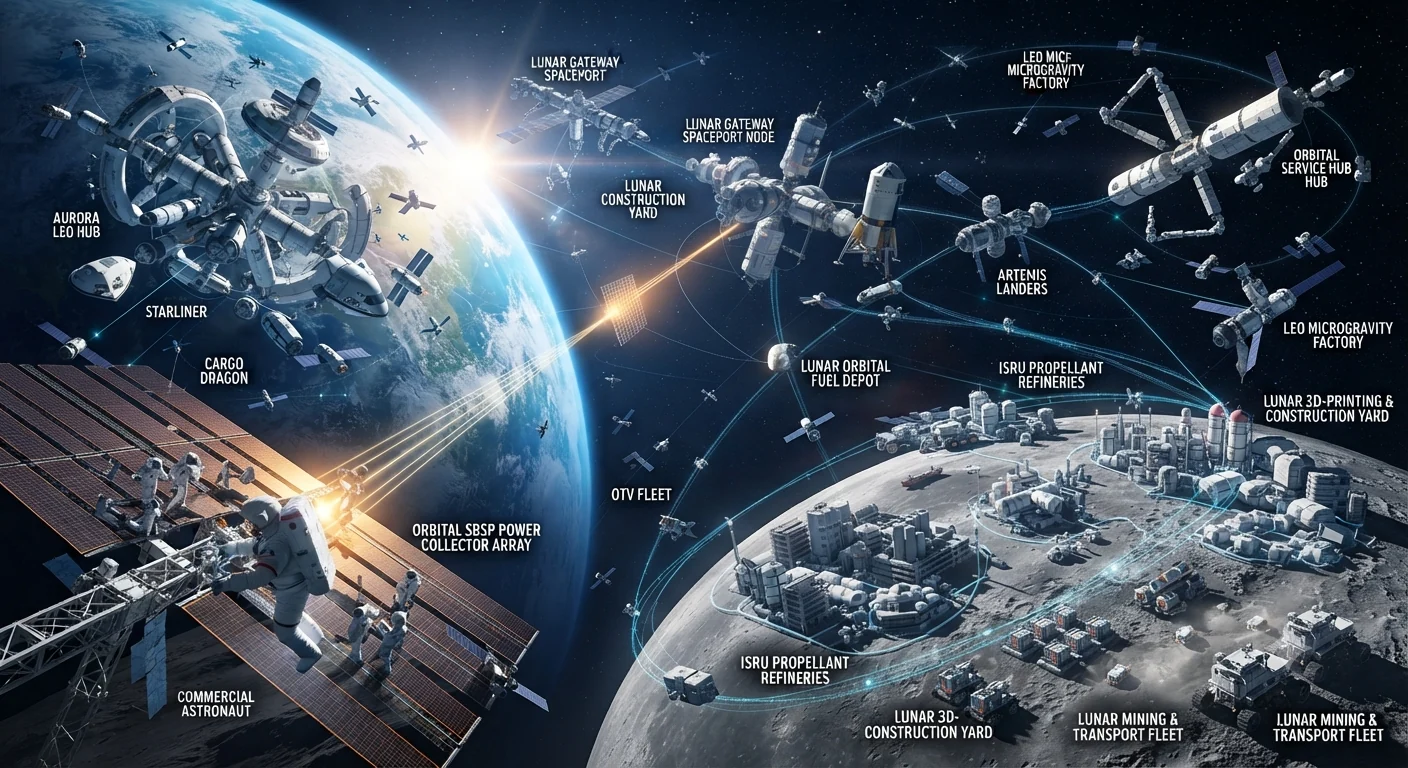
Large structures could use deployable components, assembly from separate launches, robotic assistance or human involvement. A successful deployment or robotics experiment does not prove that an autonomous construction yard is ready for routine use. Large power collectors, extensive orbital factories and integrated lunar industrial networks remain long-term concepts in this discussion. Their assessment must include inspection, repair, debris prevention, coordination and failure recovery, alongside how the parts would be assembled.
The Interconnected Horizon
These areas can share engineering knowledge, but their business cases should be tested separately. Communications revenue does not automatically finance lunar research, and software proven in one environment may need substantial changes for another. Customers, public funding, transport, operating permissions and technical dependencies determine whether a particular project can proceed.
A useful way to read a commercial-space announcement is to ask four questions: what has actually been demonstrated, under which conditions, what must still be developed, and who would use the resulting service? Distinguishing evidence from plans allows readers to recognize progress without treating every proposal as inevitable. The direction of space infrastructure will depend on practical performance, public priorities and viable operations rather than a guaranteed path to a single future economy.
Return to Space Technology or read the ASARK Space Technology Journal.
Sources & Further Reading
These sources support the station-development, lunar-services, manufacturing-research and conjunction-assessment discussions. Program milestones can change; the review date above identifies this article's editorial revision, not a guaranteed deployment schedule.
- NASA — Commercial Space Stations: program objectives and development approach.
- ESA — Moonlight: planned lunar communications and navigation services.
- NASA — Optical Fiber Production: microgravity experiments and potential applications.
- NASA — Conjunction Assessment: tracking, risk analysis and collision-avoidance guidance.
- Pembrolizumab microgravity crystallization experimentation, npj Microgravity (2019): original pharmaceutical crystallization research.