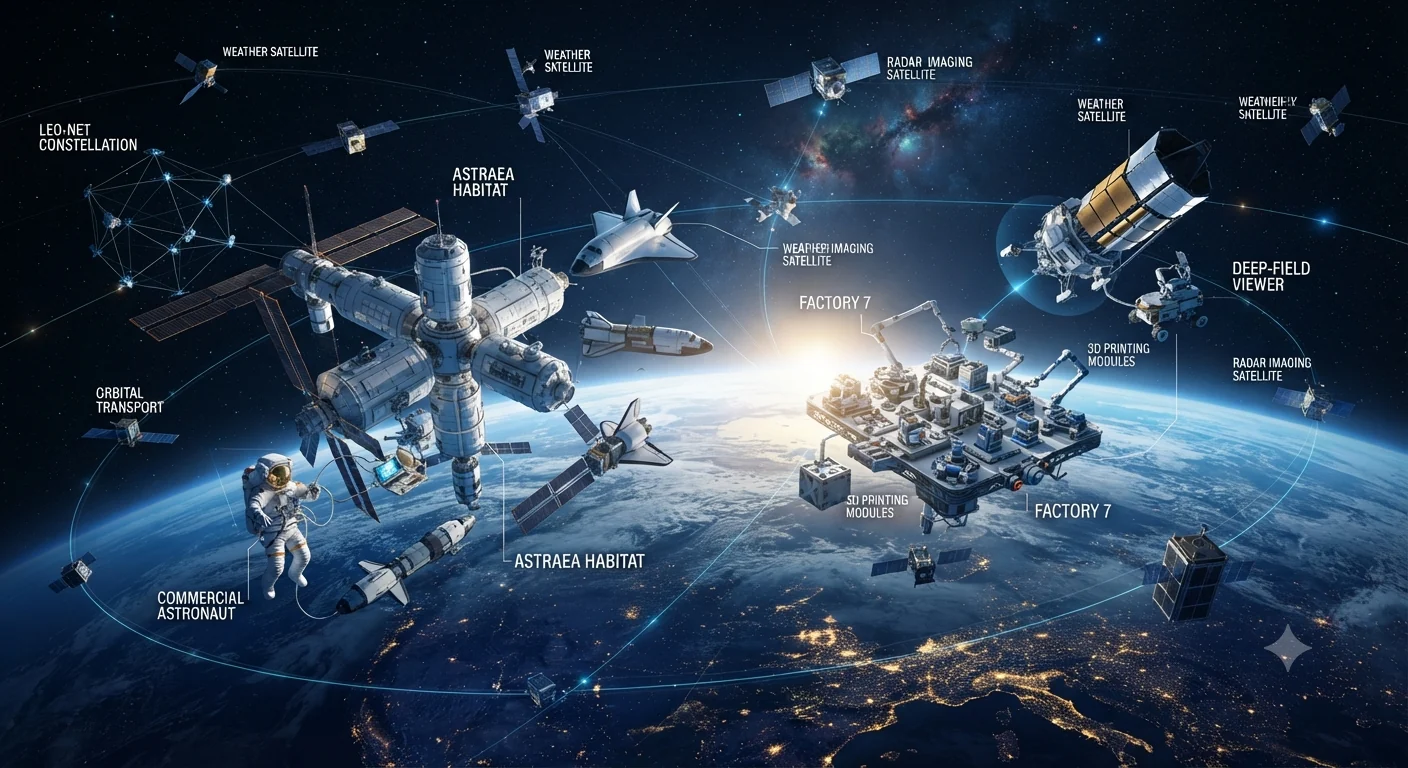
The boundary of space is not the end of a technology story. It is the point where familiar engineering must continue through vacuum, radiation, thermal extremes, delayed communication and limited opportunities for repair. A useful mission connects every decision to a purpose on Earth or to a carefully defined scientific question.
What space technology includes
Space technology includes launch systems, spacecraft, payloads, ground infrastructure, mission software and the organisations that coordinate them. A satellite is not simply a camera or a radio in the sky. It is a power system, structure, thermal design, computer, communications link, attitude-control system and set of instruments working together.
Mission teams begin with a purpose. A weather mission needs repeated observations and dependable data delivery. A navigation system needs timing, coverage and integrity. A scientific observatory needs a stable platform, a sensitive instrument and a way to transmit observations. Human missions add life support, habitat, crew health, logistics and emergency planning. Purpose prevents technology from becoming a collection of impressive but disconnected parts.
Launch vehicles and orbital motion
A launch vehicle provides the energy needed to move a payload from Earth to a planned trajectory. Rockets carry propellant and oxidiser because they cannot rely on atmospheric oxygen at high altitude. Staging discards empty tanks and engines so later stages do not have to accelerate unnecessary mass. These are conceptual principles; safe understanding does not require operational construction details.
Orbit is a continuous fall around a body. A spacecraft moving sideways fast enough can keep missing the ground as gravity curves its path. Lower orbits offer shorter communication delays and are useful for many Earth-observation missions, while higher orbits can provide wider coverage or longer visibility over a region. Inclination, altitude, eccentricity and period describe different aspects of the path.
Changing an orbit requires changing velocity. Small corrections accumulate, and the available propellant limits a mission’s options. Launch windows, lighting, ground-station visibility, radiation and traffic all influence a plan. Reusability may reduce the resources needed for some launches, but vehicle maintenance, inspection, range safety and recovery remain substantial engineering work.
Spacecraft buses and payloads
The spacecraft bus provides the common services that keep a payload alive. Solar arrays and batteries provide power. Thermal hardware moves heat and protects sensitive components. Attitude determination and control use sensors and actuators to maintain orientation. Telemetry reports health, while command systems receive authorised instructions. Structures protect the vehicle during launch and provide stable mounting for instruments.
The payload is the mission-specific part. It may be an imaging camera, radar, communications transponder, science detector, navigation clock or technology demonstration. Payload design must fit the bus’s power, mass, data and pointing limits. A high-resolution instrument is only useful when the spacecraft can point it accurately, store its data and deliver the data to users.
Spacecraft are designed with margins because the environment is uncertain. Components are tested for vibration, vacuum, temperature cycling and radiation effects. Redundancy can allow a mission to continue after a failure, while graceful degradation lets a system provide reduced service instead of stopping completely.
Communication and navigation satellites
Communications satellites connect places where terrestrial networks are expensive, damaged or unavailable. A payload receives signals, changes their frequency or direction and sends them onward. Antennas, beam coverage, spectrum coordination and ground infrastructure determine the service. Latency, capacity and weather sensitivity differ across orbital choices and frequencies.
Navigation systems provide timing and positioning from signals broadcast by satellites. A receiver compares the arrival time of several signals and estimates its location. Accurate clocks, orbital information and correction services are essential. Navigation supports transport, agriculture, emergency response, telecommunications and financial timing, so resilience and integrity matter as much as convenience.
Satellite services are part of a larger network. Ground gateways, fibre links, user terminals, standards, operators and regulatory approvals all contribute. A satellite can be healthy while a service is unavailable because a ground link, software update or power system has failed.
Earth observation, weather and climate
Remote sensing measures Earth without placing a sensor at every location. Optical instruments record reflected or emitted light. Radar can observe through cloud and darkness and can reveal surface structure or movement. Spectrometers examine wavelengths associated with materials or atmospheric conditions. The instrument converts a physical signal into data that must be calibrated and interpreted.
Weather services combine satellite observations with ground stations, aircraft, ocean measurements and numerical models. Frequent images help track clouds and storms, while microwave observations can reveal information beneath some cloud layers. Climate work depends on consistent records over time. Changing an instrument, orbit or processing method can affect the ability to compare observations, so calibration and open documentation are part of scientific quality.
Earth observation connects space to design and society. It can support crop planning, disaster response, mapping, water management and environmental research. Data is not automatically useful merely because it is high resolution. Access, licensing, local expertise, uncertainty information and ethical handling of sensitive locations shape its real value.
Telescopes and scientific missions
Space telescopes avoid parts of Earth’s atmosphere that absorb or distort light. Different instruments observe different wavelengths, and each reveals a different physical process. A telescope needs precise pointing, stable thermal conditions, calibration targets, data processing and a scientific community that can interpret the results.
Scientific missions are designed around questions rather than spectacle. They may study planetary atmospheres, stars, galaxies, the Sun, gravitational environments or the conditions needed for life. Instruments are selected for sensitivity and reliability, and observations are planned to fit power, storage and communication limits. A long mission may change its targets as new discoveries reshape the questions.
Public value includes the knowledge itself and the capabilities developed along the way. Sensors, materials, software and operations can find uses in medicine, manufacturing, environmental monitoring and education. This transfer should be described carefully; not every space invention becomes a consumer product, and discovery is valuable even when it has no immediate commercial application.
Robotics, the Moon and Mars
Robotic spacecraft explore places that are distant, dangerous or difficult for people to reach. A rover combines mobility, sensing, energy management, autonomy and communication. Because signals can take minutes or longer to travel, a rover may need to detect hazards and choose safe local actions while waiting for instructions. Autonomy does not mean independence from people; it means carefully bounded decision-making under known conditions.
Lunar missions support science, technology demonstrations and learning about a nearby world. The Moon also presents engineering challenges such as abrasive dust, long nights, extreme temperature changes and limited communication geometry. Mars adds a thin atmosphere, long delays and a complex surface environment. Each mission must distinguish what is measured from what is inferred.
Planetary protection reduces the risk of carrying Earth organisms to another world or bringing potentially hazardous material back. It is both a scientific and ethical responsibility. Exploration should preserve the ability of future researchers to study environments without confusing native evidence with contamination.
Small satellites, CubeSats and spacecraft computing
Small satellites lower the mass and sometimes the cost of entry, making focused missions more accessible to universities, startups and public agencies. A CubeSat uses standardised form factors, but a standard frame does not make a mission simple. Power, thermal control, pointing, radio links, testing and licensing remain real engineering tasks.
Space computers operate under radiation and limited energy. A charged particle can change a stored bit, interrupt a processor or damage a component. Designers use error detection, memory protection, watchdogs, redundancy and radiation-tolerant parts. Software can restart a service, place a system in a safe state and preserve enough telemetry for diagnosis.
Artificial intelligence can help process imagery, schedule observations or detect changes, but models must account for limited compute, unusual lighting, incomplete labels and the cost of a false result. Human mission teams set boundaries and review important decisions. A model that is useful on Earth may behave differently after launch because the data distribution and communication rhythm have changed.
Ground stations and mission operations
Ground stations send commands and receive telemetry and payload data. Operators schedule passes, check link budgets, manage antennas and verify that a command is authorised. Networks of stations extend coverage, while relay services can reduce the time a spacecraft waits to communicate. The ground segment is often the most visible part of a mission to users, because it turns raw signals into products.
Mission control uses procedures, simulations and checklists to manage normal and abnormal states. A command is reviewed for purpose, timing, prerequisites and consequences. Teams train for loss of communication, power anomalies, thermal excursions and sensor disagreement. Good operations are not dramatic; they are disciplined, documented and able to adapt without losing the mission’s safety boundaries.
Data processing adds another layer. Calibration, geolocation, compression, quality flags and metadata determine whether an image or measurement can be interpreted. Open archives and reproducible methods let researchers compare results and find mistakes. The chain from sensor to public information should be explainable enough for users to understand uncertainty.
Debris, law and commercial activity
Space debris includes inactive spacecraft, spent stages and fragments created by breakups. Even small objects can damage a working satellite at orbital velocity. Responsible operators track objects, design disposal plans, avoid unnecessary releases and share information. Debris mitigation is a collective problem because one operator’s fragment can threaten another operator’s mission.
Space activities are governed by national licensing and international agreements. Registration, liability, spectrum coordination, remote sensing rules and launch safety create responsibilities beyond the engineering team. Commercial activity can bring investment and useful services, but public value depends on transparency, competition, worker safety, environmental care and clear accountability when a private system affects shared orbital space.
International cooperation is visible in shared missions, data agreements, tracking networks and scientific programmes. Cooperation can reduce duplicated effort and create standards, while competition can accelerate investment. Both need guardrails that discourage harmful interference and protect peaceful scientific and civilian use.
Human spaceflight and orbital habitats
Human spaceflight turns a spacecraft into a temporary living environment. Air, water, food, temperature, waste management, lighting, exercise and medical support must remain within safe limits. A station is both a laboratory and a home, so engineering decisions affect attention, sleep, teamwork and wellbeing. Crews train extensively, while ground specialists continue to monitor systems and plan work. The achievement is collective rather than individual.
Microgravity changes how fluids move and how bodies use muscles and bones. Experiments study these effects while testing materials, biology and manufacturing processes. Results require careful controls because launch vibration, radiation and small samples can complicate interpretation. Human research also carries consent and privacy responsibilities. The goal is knowledge that protects participants and improves future mission design.
Habitats rely on maintenance. Filters are replaced, surfaces inspected, software updated and small failures investigated before they grow. Future journeys farther from Earth will have fewer immediate resupply options, increasing the value of repairable components, common interfaces and useful local diagnostics. Autonomy here means helping a crew understand and manage a system, not removing human judgement from safety decisions.
Reusable systems and the economics of access
Reusability aims to recover hardware that would otherwise be discarded. Its value depends on the complete operating cycle: recovery, transport, inspection, refurbishment, testing and scheduling. A recovered stage is not automatically ready to fly again, and different missions impose different demands. Meaningful comparisons consider reliability, total resources, launch cadence and required ground infrastructure.
Lower launch prices can enable more science, communications and Earth observation, but launch is only one part of a mission budget. Spacecraft development, licensing, insurance, operations, data processing and end-of-life disposal continue after liftoff. Standard interfaces and shared rides may improve access for small organisations, while creating constraints around schedule, orbit and deployment.
Commercial investment has broadened services offered from orbit. Healthy markets need accurate claims, clear responsibility and competition that does not transfer environmental or safety costs to the public. Governments remain regulators, scientific customers and stewards of shared resources. A durable space economy connects private initiative with public accountability.
Radiation-resistant electronics and mission software
Every spacecraft depends on semiconductors, from power switches and memory to sensors and communications. Radiation can deposit charge in circuits, change a stored bit or gradually degrade a device. Engineers respond with radiation-characterised parts, shielding, redundant computation, error-correcting memory and software that detects a fault and enters a safe state. The appropriate solution depends on orbit, mission duration and consequence of failure.
Space computing involves trade-offs. The newest terrestrial processor may offer impressive speed but lack evidence needed for a long mission. A mature device with known behaviour can be more valuable. Designers balance performance, electrical power, heat, mass, tool support and repair options. Increasingly, spacecraft combine dependable control computers with more capable processors dedicated to imagery or science.
Software is tested against simulated sensors and faults before flight. Teams trace requirements to code, review commands and preserve configuration history. Updates can correct problems, but an interrupted or incompatible update can endanger a mission. Secure signing, staged installation and a recoverable previous version reduce that risk.
AI, autonomy and data at planetary scale
Satellites produce more data than can always be transmitted immediately. Onboard processing can discard unusable frames, compress observations or prioritise a warning. Machine learning may identify clouds, fires or changes, but models have to operate within strict power and memory limits. Performance must be tested across seasons, regions, sensor ageing and conditions absent from training data.
Mission planning is a constrained scheduling problem. Instruments compete for power, storage, pointing time and communications. Software can propose efficient schedules and re-plan after weather or an anomaly, while human controllers retain authority over mission risk. Explainable constraints and auditable decisions matter more than an impression of intelligence.
Once data reaches Earth, calibration and context remain essential. A colourful image is not the same as a measurement. Responsible services show uncertainty, preserve provenance and explain transformations. When observations affect insurance, agriculture, security or disaster response, teams must consider privacy, unequal access and consequences of a mistaken classification.
Planetary protection, cooperation and governance
Exploration can contaminate the places it seeks to understand. Planetary-protection practices reduce transfer of terrestrial organisms to environments where they could confuse future evidence, and guide safe handling of returned material. Requirements vary with destination and mission. They express scientific humility: today’s mission should not make tomorrow’s question impossible to answer.
The international framework treats exploration as an activity carried out for the benefit of all countries and makes states responsible for national activities. National rules address licensing, liability, registration, spectrum and remote sensing. New activities raise questions about resources, traffic and preservation of scientifically valuable locations. Governance develops more slowly than hardware, making early transparency important.
Cooperation distributes cost and expertise. Instruments from one country may fly on another country’s spacecraft and data may be shared worldwide. Common tracking messages and radio standards improve safety. Cooperation requires clear roles, sustained funding and ways to resolve disagreement. Its value is that no single organisation has to understand the universe alone.
A responsible programme also explains what it will not do. Boundaries around surveillance, harmful interference, contamination and unsafe disposal turn values into engineering constraints. Procurement can require evidence of responsible end-of-life design, while research agreements can define suitable data access. These commitments should be reviewed as capabilities change.
The future will bring surprises that no roadmap predicts. Flexible institutions can learn without abandoning safety or public purpose. They preserve core knowledge, invite independent review and make decisions at a pace supported by evidence. Exploration earns confidence when curiosity, competence and care travel together.
Communication, trust and public understanding
Space communication includes the stories told about missions. Agencies and companies should distinguish confirmed performance from goals, simulations and projections. A launch announcement can explain uncertainty without diminishing achievement. Clear language builds durable trust because audiences can understand how knowledge changes after new evidence.
Images deserve similar care. Colours may represent wavelengths people cannot see, and maps may combine several observations or models. Captions should identify processing and uncertainty. Visualisation is not decoration: it is an interface between measurement and public interpretation.
Mission names and national symbols can inspire participation, but science remains international and cumulative. A result often depends on earlier catalogues, shared standards and instruments built across borders. Crediting those contributions demonstrates how modern exploration actually works and gives learners more paths into the subject.
Journalism and education can ask about cost, risk and environmental effect while celebrating discovery. Critical questions are not hostility to exploration; they help programmes improve. Conversely, criticism should be grounded in evidence and recognise that engineering decisions involve trade-offs rather than perfect options.
Public engagement is strongest when it continues between launches. Open data challenges, museum programmes, classroom resources and accessible mission updates turn distant machines into opportunities to learn. People with disabilities should be considered through captions, transcripts, colour choices and navigable digital tools.
As activity grows, society will need a richer vocabulary for orbit, spectrum, debris, remote sensing and planetary protection. Understanding these systems supports better democratic choices. Space technology belongs not only to specialists who build it, but also to the communities who fund it, use its services and inherit the environment it leaves behind.
How a space programme learns
Space programmes build capability through sequences of missions. An early spacecraft may demonstrate navigation or an instrument; a later mission combines that knowledge with greater autonomy or a more demanding destination. Treating every flight as an isolated spectacle hides the value of continuity. Teams learn how hardware ages, how suppliers perform and which operational assumptions deserve revision.
Failure is possible even in a disciplined programme. Useful organisations investigate evidence, separate immediate causes from organisational conditions and share lessons at an appropriate level. A component can fail because of a defect, but schedule pressure, unclear ownership or inadequate testing may have allowed the defect to matter. Learning requires technical depth and a culture that welcomes inconvenient information.
Success also deserves analysis. A mission that worked may still have consumed unnecessary margin or depended on an unrecognised coincidence. Post-mission review records what should be repeated and what should be changed. Without that work, confidence can grow faster than capability.
Supplier relationships are part of learning. Space hardware often comes from specialised firms with long lead times. Clear requirements, traceability and early testing allow a supplier to raise concerns before integration. Diverse supply can improve resilience, but substituting a component requires evidence because parts with similar descriptions may behave differently under radiation or temperature.
Simulation connects teams before hardware exists. Digital models explore power balance, thermal conditions, orbit geometry, communications and operations. Hardware-in-the-loop tests add real computers or sensors to simulated environments. Models are valuable when assumptions and validation are visible; an elaborate simulation can still mislead when its inputs are wrong.
Knowledge transfer matters over long schedules. Engineers may change roles between design and arrival at a distant planet. Decision records, interface documents and mentoring preserve reasoning that raw drawings cannot. Archives should capture why a limit exists, not only the number itself.
Design for uncertainty
Spacecraft cannot be repaired easily, so they are given margins and safe modes. Margin accounts for uncertainty in mass, power, performance and environment. It should be managed rather than quietly consumed. A project that reports margin honestly can make deliberate decisions before launch.
A safe mode reduces activity to protect power, temperature and communication while controllers investigate. Entering it is not necessarily failure; it is a planned response to uncertainty. The design challenge is ensuring the triggers are reliable and recovery instructions remain valid after years in flight.
Redundancy can duplicate a component or provide a different way to achieve a function. Identical copies may share the same hidden defect, while diverse designs add complexity. Teams analyse common causes such as shared power, software or connectors. More hardware is not automatically more reliable.
Radiation and thermal cycles make uncertainty time-dependent. Engineers use ground tests and models to estimate lifetime, then monitor trends in flight. Operating a component more gently may extend the mission. Scientific schedules can change when preserving a critical system creates more long-term value than one additional observation.
Communications loss is planned for because geometry, weather or equipment can interrupt a link. Spacecraft may store data, follow a timed plan and attempt contact later. Ground networks coordinate antennas and priorities. Clear procedures prevent several well-intentioned teams from sending conflicting commands.
Navigation far from Earth combines radio tracking, celestial references and onboard sensors. Each measurement has uncertainty. Estimation software combines evidence over time rather than treating one reading as absolute. This principle—confidence built from independent observations—runs throughout scientific engineering.
Space technology in daily life
Weather forecasting is one of the clearest public connections. Satellites observe cloud, temperature, moisture and motion across areas where ground measurements are sparse. Forecast models integrate these observations with physical laws. The forecast is a probability-informed estimate, so communication should express uncertainty without making the information useless.
Disaster response uses communications, navigation and imagery together. A map can show damaged routes, while satellite connectivity supports coordination and positioning guides responders. Timeliness and interoperability matter as much as resolution. Data delivered after a decision window may have archival value but limited emergency value.
Agriculture can use Earth observations to understand vegetation and moisture across large regions. Local interpretation remains important because crops, soil and practice vary. Satellite products should complement field knowledge rather than present remote sensing as a replacement for farmers.
Scientific timing from space supports telecommunications, power networks and measurement. This dependency is easy to overlook because receivers operate quietly. Resilience plans may combine multiple constellations, terrestrial timing and procedures for degraded service.
Education gains from open images and mission data. Students can work with authentic observations and see how physics, code and design connect. Accessible tools and documentation turn public investment into broader capability. Inspiration becomes more durable when it is paired with the means to learn.
Ultimately, a space system succeeds when people can rely on its knowledge or service while the mission respects shared environments. The rocket is memorable, but patient engineering, operations and stewardship create lasting value.
Designing missions as complete public systems
A mission begins long before hardware reaches a launch site. Scientists and users define a question or service, engineers translate it into measurable requirements, and programme teams consider cost, schedule and risk. Early choices determine orbit, instruments, communications and operations. A clear purpose protects against feature growth because every added capability consumes mass, power, testing time and attention.
Systems engineering maintains connections among choices. A larger antenna can improve a link while changing structure and pointing. More computing can reduce downlink demand while increasing power and heat. Additional redundancy can improve fault tolerance while creating more interfaces to verify. Trade studies make these relationships visible and record why a design was chosen.
Testing creates evidence. Components, subsystems and the integrated spacecraft are checked against vibration, acoustic loads, vacuum and temperature cycles. Software simulations exercise cases unsafe or expensive to reproduce physically. Testing cannot prove no failure is possible; it reduces uncertainty and prepares teams to recognise unexpected behaviour.
Mission assurance includes configuration control. Teams must know which drawing, software build and procedure corresponds to flight hardware. A small undocumented change can invalidate earlier evidence. Reviews challenge assumptions, but their quality depends on openness. Engineers must be able to report doubt without being treated as obstacles.
Operations continue this discipline after launch. Telemetry trends reveal gradual change, while anomaly teams compare explanations before sending commands. Time pressure makes predetermined authority valuable. A safe response may preserve power and wait for evidence instead of attempting a dramatic recovery.
End-of-life planning belongs at the beginning. Propellant, passivation and disposal orbit or re-entry options should be included in design. Waiting until a spacecraft is failing can leave too little control. Long-lived debris imposes costs on people who did not benefit from the original mission.
Public missions need durable archives. Instrument data without calibration history, timing and processing documentation can lose scientific value. Open formats allow future researchers to reinterpret observations with better methods. Stewardship turns a short mission into a longer contribution.
Earth services and local capability
Satellite data becomes useful through institutions on Earth. A flood map needs recent observations, terrain data, communication and responders who understand uncertainty. A farm advisory needs accessible language and local knowledge. The spacecraft is one element of a service chain; training and distribution often determine public benefit.
Navigation illustrates this dependency. Spacecraft broadcast precise timing, control centres estimate paths, monitoring stations assess quality and receivers combine measurements. Transport and communications may rely on that timing. Backup plans and integrity warnings matter because a quiet error can be more harmful than an obvious outage.
Communications constellations can extend connectivity where terrestrial infrastructure is sparse. Their value should be assessed with affordability, terminal energy, spectrum, astronomy and orbital traffic in view. A global service still has local consequences and must respect community needs.
Earth observation has similar tensions. High-resolution imagery supports response and planning but can reveal sensitive activity. Policies should define access, retention and appropriate resolution. Public-interest programmes can make environmental information available while protecting individuals and vulnerable locations.
Climate monitoring depends on continuity. Long records distinguish variability from trends, but instrument changes can introduce breaks. Overlapping missions, careful calibration and transparent algorithms preserve comparability. The most important spacecraft may quietly measure the same variable accurately for years.
Exploration beyond immediate utility
Science missions do not always produce an immediate service, yet they expand the shared map of reality. Measurements of planets, stars and fundamental physics test ideas unavailable on Earth. Their value includes education and a culture willing to ask difficult questions, not merely commercial products.
Lunar exploration can study geology, volatile materials and solar-system history. Repeated missions may test navigation and surface operations. Activity should preserve historic and scientifically distinctive sites. The Moon is a record that careless operations could permanently alter.
Mars missions combine orbital observation, instruments, rovers and research on Earth. Claims about habitability or life require care because chemical and geological processes can resemble biological signatures. Reproducible data and multiple lines of evidence protect discovery from excitement outrunning measurement.
Deep-space missions expose another dimension of design: patience. Communication may take hours and sunlight may be weak. Hardware operates for decades, and teams pass knowledge across generations. Durable documentation and institutional memory become engineering components.
Not every destination needs a human crew. Robots accept environments and timescales people cannot. Human presence adds flexible observation and cultural meaning, but also life-support risk and resources. Responsible planning compares options honestly.
A fair and sustainable space future
Orbital capacity is shared. Popular altitude bands and radio frequencies can become congested. Operators need accurate tracking, timely manoeuvre communication and designs that fail safely. No single organisation can keep orbit usable alone.
Debris removal may complement prevention, but it raises legal and security questions because approaching an object resembles approaching an active spacecraft. Consent, ownership and transparent coordination are essential. Prevention remains the dependable starting point.
Launch and re-entry affect the atmosphere and communities near facilities. Evidence continues to develop, so assessment should follow changing knowledge. Local consultation, measurement and reporting help ensure benefits are not separated from costs.
Access to education and data can broaden participation. Universities and small organisations benefit from shared facilities, standard platforms and open archives. Inclusion does not lower safety standards; it makes knowledge, review and support available to more capable teams.
The best future infrastructure will be quiet in reliability and ambitious in purpose. It will connect communities, improve warnings, extend science and preserve orbit. Human value comes from missions that deepen knowledge and care for life while accepting exploration has limits.
India and responsible futures
India’s space ecosystem includes ISRO missions, launch vehicles, satellites, Earth-observation services, universities, suppliers and an expanding private sector. Applications in weather, navigation, communications, agriculture, disaster response and education connect national capability to daily life. The long-term strength of the ecosystem depends on research, manufacturing quality, ground infrastructure, skilled people and opportunities for new organisations to learn responsibly.
The next phase may include more capable small satellites, reusable systems, lunar science, advanced Earth observation, space science and commercial services. Future infrastructure should be judged by reliability and public benefit rather than by launch frequency alone. Open data where appropriate, transparent procurement and careful impact assessment can help prevent concentration of benefits.
Space technology asks a human question: what should be extended beyond Earth, and why? Satellites can protect lives by improving forecasts. Telescopes can change how people understand their place in the universe. Robotics can test ideas before humans take greater risks. At the same time, orbital congestion, environmental cost and unequal access are real constraints. A responsible future combines ambition with restraint.
Explore ASARK’s Space Technology hub, follow the semiconductor foundations of spacecraft electronics, or read the Semiconductor Technology Journal and Market Technology Journal for related systems.